

Basic structure of industrial robots
20-03-2026 12
The basic structure of an industrial robot consists of four main components: a drive system, a gearbox, an encoder, and a power transmission system, along with an end-effector. These parts work together to enable the robot to perform precise, stable, and flexible movements in a production environment.
In the field of production automation, industrial robots play a vital role in helping businesses optimize productivity, enhance precision, and minimize operating costs. To understand how robots operate so effectively, grasping the basic structure of an industrial robot is essential. Join Intech Robotics to explore the details in the article below:
Definition of Industrial Robots
An industrial robot is an automated mechatronic device, pre-programmed to perform complex or repetitive tasks with high precision and speed. Industrial robots can handle various tasks in a production line, such as welding, assembly, spray painting, packaging, material handling and palletizing, laser cutting, CNC machining, or performing precise operations in electronic component assembly.
With the ability to operate continuously 24/7, industrial robots deliver superior performance compared to manual labor. The system is also easily reprogrammable to suit each production stage while maintaining precision, with an error margin of only approximately ±0.02mm.
Currently, robots are designed with many different structures and axis configurations, such as 4-axis, 5-axis, 6-axis, SCARA, Delta, or Cartesian robots, meeting diverse production needs across various industries.
For example, in the food industry, 4-axis robots are often used to load packages onto conveyors or pallets with weights up to 50kg per bag.
Differences Between Robot and Human Structures
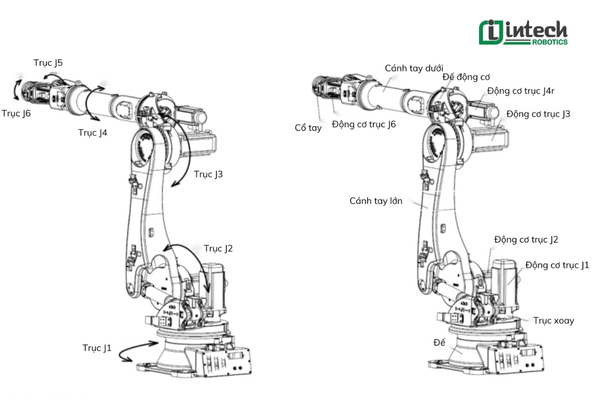
Mechanically, industrial robots and humans share similar structural principles consisting of links (bones) and joints that create flexible movement. In a robot, links are the rigid parts forming the "skeleton," while joints are the connection points that allow the robot to perform rotating, folding, or extending movements—similar to human shoulders, elbows, and wrists.
Depending on the arrangement of links and joints, industrial robots are divided into two main categories:
- Serial Robots: Joints are arranged in a series, similar to a human arm. This type of robot is commonly used in assembly, welding, or painting lines.
- Parallel Robots: Joints and links are arranged in parallel, helping to increase rigidity and speed, suitable for applications requiring high precision such as high-speed machining or packaging.
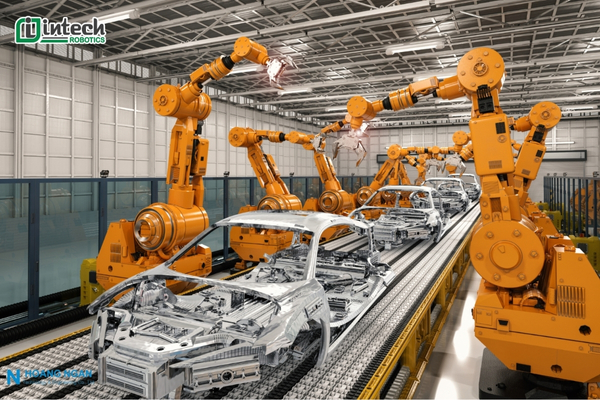
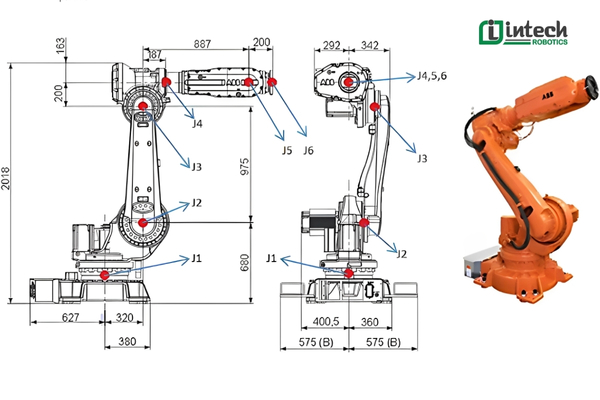
For example, a 6-axis vertical articulated robot simulates human arm movements with 6 main joints:
-
The first three joints (Axes 1–3) act as the "waist" and "arm," helping to determine the position of the wrist.
-
The last three joints (Axes 4–6) control the orientation and rotation angle of the wrist, allowing the robot to flexibly manipulate in all directions.
This structure allows the robot to perform complex human-like movements, such as gripping, rotating, welding, or assembling in three-dimensional space with high accuracy.
Basic Structure of an Industrial Robot
Fundamentally, an industrial robot consists of four main components that determine the operational capability and precision of a pick-and-place robot: the actuator, gearbox, encoder, and power transmission system. Specifically:
Actuator
The actuator is where energy (electrical, hydraulic, or pneumatic) is converted into mechanical motion. This component acts as the "joints" that help the robot move, lift, rotate, or reach desired positions.
In modern industrial robots, servo motors are commonly used because of their ability to precisely control position, speed, and torque with extremely low error margins, only ±0.01mm. Additionally, while robots primarily use electric drives, in specific environments (such as heavy-duty robots or working under high-pressure conditions), hydraulic and pneumatic drives are applied to increase power and durability.
Gearbox / Reducer
The gearbox helps increase torque and control the rotational speed of the motor, allowing the robot to operate more stably and powerfully. This mechanism is similar to a bicycle's gear system that changes the gear ratio to achieve stronger pulling force or higher speed when needed. This component is used in applications requiring large forces such as welding, assembly, or lifting heavy products.
Encoder
The encoder helps determine the position, rotation angle, and speed of each axis. This device uses an optical disk with evenly spaced slits, combined with LED sensors and photodiodes to record the rotational movement of the motor shaft.
Information from the encoder is sent back to the controller, allowing the servo system to calculate and adjust the position of the industrial robot arm in real-time, ensuring extremely high accuracy and repeatability.
Power Transmission System
The power transmission system is responsible for transmitting power from the motor and gearbox to the joints or other moving parts of the robot. This structure can include belts, drive shafts, or gears, allowing for changes in direction, speed, and the magnitude of the transmitted force.
Depending on the design, the motor can be placed near or far from the joints using intermediate transmission mechanisms. This helps the robot have a more compact design, especially in the wrist area.
End-Effector
The end-effector is the part attached to the end of the robot arm that directly contacts and manipulates objects. Depending on the application, the robot can change tools such as:
-
Mechanical grippers or vacuum suction grippers for lifting, picking, or moving products.
-
Welding torches, paint guns, or glue dispensers for applications in automotive or electronics manufacturing.
The ability to flexibly swap end-effectors allows industrial robots to perform many different tasks on the same line, increasing production efficiency and flexibility.
Conclusion
Understanding the basic structure of an industrial robot is an important step in helping businesses grasp the operating principles and practical application capabilities of each type of robot in production. Grasping this structure not only helps businesses choose the right type of robot for their production line but also supports the maintenance process, operational optimization, and future automation scaling.
If you are looking for a suitable industrial robot solution for your business, contact Intech Robotics today. Our team of highly specialized engineers is ready to accompany your business on the journey to building smart factories and elevating production productivity.
