


Learn about automated packing and loading solutions.
20-03-2026 16
Automated packaging and handling solutions are becoming an inevitable trend, replacing manual processes with industrial robotic systems that offer superior accuracy and speed.
With years of experience in deploying production automation and installing smart factories for domestic and international partners, Intech Robotics provides industrial robots and fully automated palletizing stations. These systems integrate modern technology and flexible application capabilities across various manufacturing industries. Explore more with us in the following article:
What is an Automated Palletizing System?
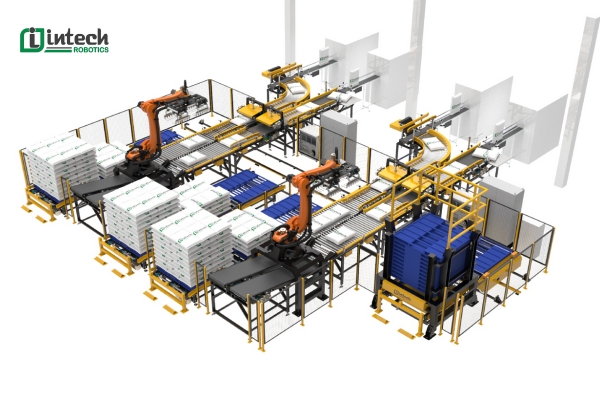
An automated palletizing system is a collection of equipment such as industrial robots, conveyors, smart sensors, and a central controller designed to perform the entire handling and stacking process without direct human intervention.
The system operates based on sensors that collect data regarding the size, weight, and shape of each package. Subsequently, control software processes this data and programs the palletizing robot to follow an optimized trajectory, ensuring that operations take place quickly, accurately, and safely.
Advantages of Automated Palletizing Systems
During the implementation of automated packaging and palletizing solutions, Intech Robotics summarizes the outstanding advantages of this system as follows:
- Industrial robots are capable of continuous 24/7 operation without interruption, helping to increase palletizing productivity and optimize production line efficiency.
- All operations are precisely programmed according to a pre-defined process, ensuring consistency and minimizing errors in the handling stage, especially with goods of inconsistent sizes or weights.
- Reducing the amount of direct labor while cutting down on training and management costs brings sustainable economic benefits.
- Robot systems eliminate manual operations in environments with potential occupational safety risks, such as lifting heavy goods, working near machinery, or in confined spaces.
Operational Workflow of an Automated Palletizing System
An automated palletizing system is designed to optimize the entire process of transporting and arranging goods in factories or logistics centers. Specifically, the operational workflow takes place as follows:
Step 1: Goods Reception
Finished goods from the production line are fed into the automated palletizing system via conveyors or Automated Guided Vehicles (AGV/AMR).
Step 2: Data Collection
Smart sensors, such as weight sensors, vision sensors, or barcode scanners, collect information on the size, weight, and shape of each package in preparation for the next processing step.
Step 3: Information Processing and Motion Programming
The central control system (PLC/IPC) analyzes sensor data and calculates the most optimal palletizing plan, subsequently sending control commands to the robot.
Step 4: Robotic Palletizing Execution
The industrial robot proceeds to lift, rotate, and place goods onto pallets, transport vehicles, or containers according to the programmed layout, ensuring absolute precision and safety.
Step 5: Transport to the Next Location
Upon completion, goods are moved to storage or shipping areas using conveyor systems, AGVs, or mobile robots. The entire process occurs continuously, automatically, and is monitored in real-time.
Essential Handling Equipment for a Modern Factory
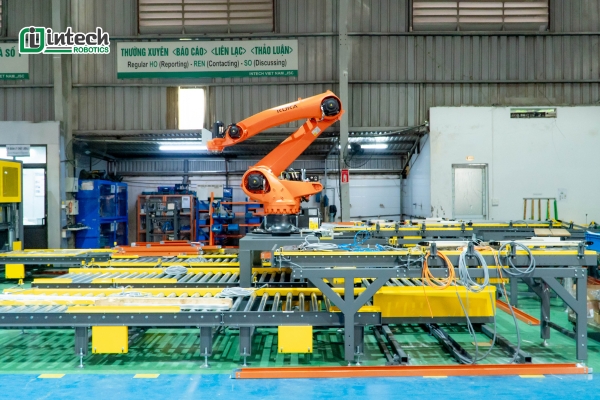
Selecting and integrating the right equipment is the decisive factor for the operational efficiency of Automated Packaging and Palletizing Solutions. A smart factory needs to be equipped synchronously with the following systems:
Conveyor System
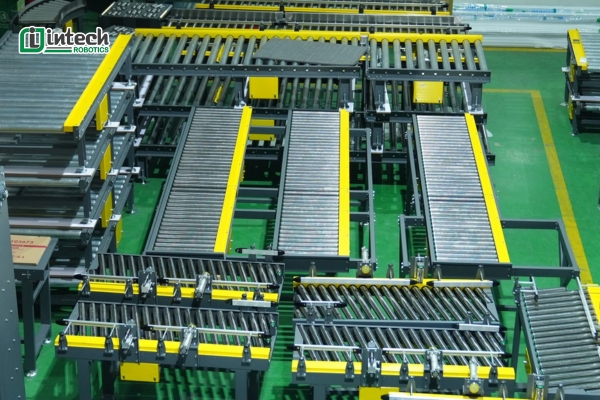
The Conveyor System handles the role of transporting goods in various directions from production areas to palletizing, packaging, or storage areas. When combined with counting sensors, weighing sensors, stop sensors, and a central controller, conveyors can automatically sort packages by size, weight, or product code.
Industrial Robot Arm
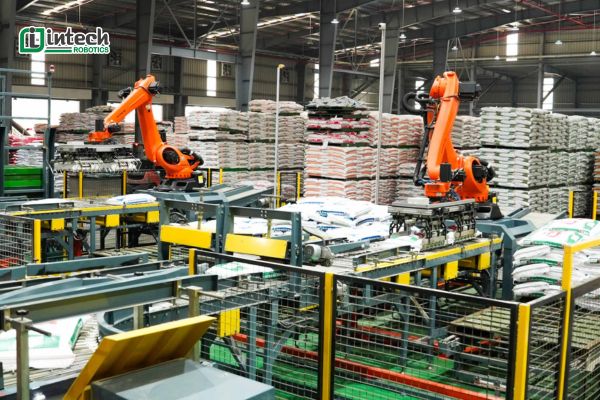
A six-axis industrial robot arm is the core equipment that performs precise operations such as picking, arranging, lifting, or vacuum-handling products. With a reach of over 3m, it can work in wide spaces and remains flexible across many angles.
Robots are capable of identifying the shape and position of goods and automatically optimizing the palletizing cycle through the integration of modern sensors and intelligent algorithms. Consequently, businesses can increase processing speeds, reduce errors, and limit the risk of product damage during transport.
Smart Sensors
Automated Guided Vehicle (AGV)
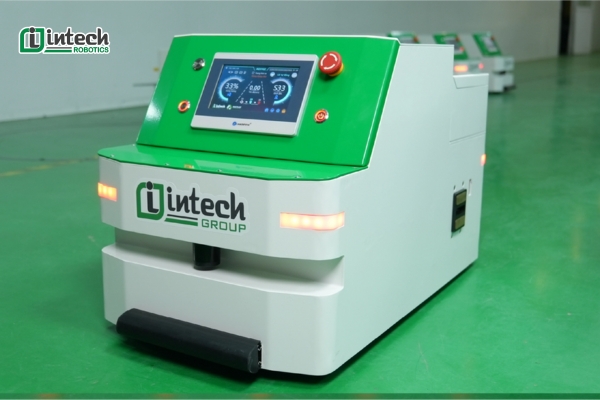
An AGV is a fully automated transport device operating within factory or warehouse areas based on navigation technologies such as laser, magnetic tape, cameras, or internal GPS. AGVs are designed to move pallets or heavy packages along pre-defined routes and feature intelligent collision avoidance thanks to safety sensor systems.
Smart Warehouse
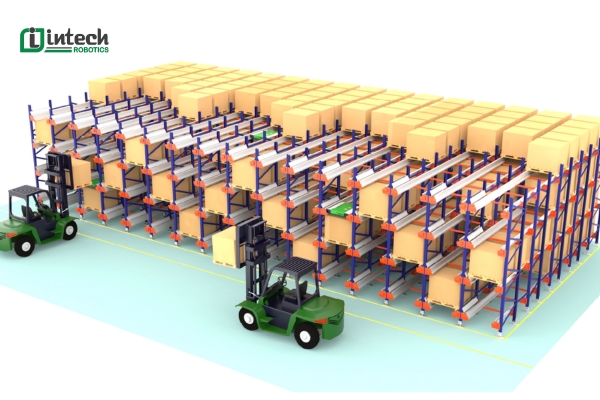
An automated smart warehouse is designed to maximize vertical space, helping businesses save floor area while automatically arranging and retrieving goods using robots or conveyors.
Smart warehouses ensure that goods are managed in an organized, safe, and rapid manner, meeting high-volume storage requirements in logistics, FMCG, pharmaceutical, and electronic industries.
Warehouse Management System (WMS)
WMS software helps monitor and coordinate all activities from reception and storage to shipping. WMS updates data in real-time, allowing businesses to accurately control the location, quantity, and status of goods while efficiently allocating the activities of robots, conveyors, and AGVs.
Automated Packaging and Palletizing Trends in Modern Factories
The following prominent trends are shaping the future of the smart manufacturing industry.
Development of Robotics and Artificial Intelligence (AI)
Industrial robots combined with Artificial Intelligence not only perform precise, high-speed operations but also have the ability to learn and optimize workflows based on real-world data. From there, robots can automatically adjust palletizing force, identify different products, and arrange goods according to optimal models.
Integration of IoT and Blockchain
The integration of IoT (Internet of Things) and Blockchain technology into automated palletizing systems enhances the ability to track, manage, and retrieve goods in real-time.
-
IoT allows sensors and devices in the production line to connect with each other, continuously collecting and transmitting data.
-
Blockchain ensures transparency and data security throughout the entire supply chain.

Development of Automated Machinery and Flexible Equipment
Automated packaging and palletizing equipment is increasingly being developed to be multi-tasking, flexible, and easy to integrate into existing production lines. Modern machinery can handle various product types with different sizes and automatically switch working modes without complex programming.
Application of Automated Packaging and Palletizing Solutions in Industries
Automated packaging and palletizing solutions are not limited to the logistics sector but are expanding strongly into many key manufacturing industries, helping to improve efficiency and output quality.
Food and Beverage Industry (F&B)
In the F&B industry, speed and precision are vital factors. Automated packaging and palletizing systems help increase productivity, ensure food hygiene and safety, and minimize the risk of damage during the packaging and transport process.
Pharmaceutical and Medical Industry
The specific nature of the pharmaceutical industry requires precision, traceability, and strict hygiene standards. Automated robotic packaging systems help ensure that each product is handled according to the correct process, dosage, and GMP standards, while minimizing cross-contamination risks.
Electronics and High-Tech Industry
Automated packaging and palletizing systems help control the force, position, and order of goods stacking, ensuring that components are not impacted or deformed during transport.
Guide to Choosing the Right Automated Packaging and Palletizing Solution
Investing in an automated palletizing and packaging system is a strategic step that helps businesses improve production efficiency, but it is also a significant investment that requires careful calculation from the planning stage. Below are the factors businesses need to consider before implementation.
Step 1: Determine Actual Needs and Scale
First, businesses need to clearly analyze the volume of goods, the frequency of inbound/outbound warehouse activities, and the available space.
-
If the warehouse scale is small but requires high turnover speeds, automated conveyor systems and robotic palletizing stations are the optimal choice.
-
Conversely, for warehouses with large areas and frequent activities, businesses should invest in industrial palletizing robots and conveyor systems combined with AGVs or AMRs to ensure higher performance and flexibility.
Step 2: Evaluate Integration Capability with Existing Infrastructure
Before installing a new system, it is necessary to check the compatibility of the solution with the warehouse layout, technological infrastructure, and software currently in use. An effective system must connect smoothly with ERP, WMS, Wi-Fi, 5G, or Cloud systems so that operational data is synchronized in real-time.
Step 3: Prepare the Operations Team and Training Plan
Businesses need to build a training plan for technicians, maintenance staff, and system managers to ensure long-term stable operation, minimize risks, optimize operational processes, and increase equipment lifespan.
Step 4: Select a Reputable Solution Provider
Prioritize choosing a provider with a highly specialized engineering team and full-service offerings from consulting - design - installation - training - maintenance, ensuring they accompany the business throughout the operational process.
Intech Robotics, a member of Intech Group, is one of the leading units in Vietnam providing automated packaging and palletizing solutions. With years of experience implementing for domestic and international enterprises, Intech Robotics brings comprehensive, effective, and cost-optimal solutions that meet the needs of every business.
Conclusion
The combination of industrial robots, conveyors, AGV systems, and smart warehouse management software is the key to helping businesses increase competitiveness, ensure quality, and expand production scale sustainably.
If your business is looking for the most effective and suitable automated packaging and palletizing solution, Intech Robotics is always ready to accompany you quickly and effectively.
