


What is a palletizing robot? Specific characteristics, structure, and features
20-03-2026 14
A palletizing robot (also known as a palletizing robot) is an industrial robotic device designed to fully automate the process of stacking and moving goods onto pallets.
With the combination of sensors, precision mechanical structures, and control software, robots can quickly, accurately, and safely handle products in production lines, packaging, or logistics.
Currently, palletizing robots are applied in manufacturing plants, warehouses, and logistics centers to increase productivity, reduce labor costs, and optimize storage space. Join Intech Robotics to learn in detail about the characteristics, operating principles, and construction in the article below:
Technical Specifications of Palletizing Robots
Unlike collaborative robots (cobots), palletizing robots operate independently with high payload capacities, suitable for factories that need to handle heavy goods at high frequencies.
- Robots are designed with 4-5-6 degrees of freedom, moving in three-dimensional space. Businesses can choose single-arm or dual-arm robots to enhance productivity and optimize installation area.
- Robots have a defined cycle time, making it easy to calculate throughput and plan production. For products weighing from 10–50kg, the stacking speed can reach 30–100 cycles per minute.
- Integrated with smart sensors and precision control software, ensuring a positional repeatability of approximately 0.06mm, operating continuously 24/7 without interruption.
- Robots can palletize bags, boxes, or crates weighing from 50 - 100kg. Thanks to overload sensors and integrated safety systems, the robot automatically stops or adjusts when an obstacle is detected.
- Palletizing robots are designed for easy installation and operation, with quick setup via a user-friendly interface that helps businesses shorten deployment time and achieve a faster return on investment (ROI).
Operating Principle of Palletizing Robots
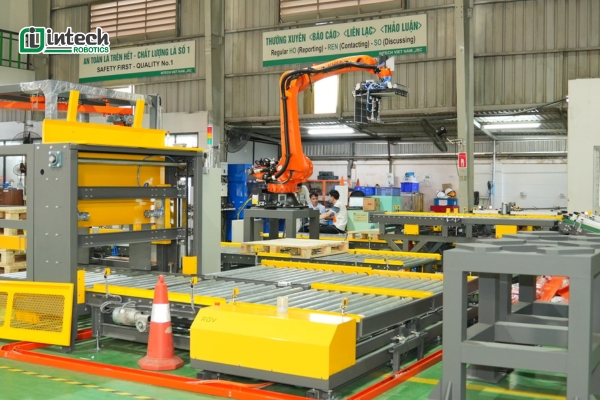
Palletizing robots operate on the principle of automating the process of stacking goods onto pallets using industrial robotic arms. This is the final stage in the production or packaging line.
During operation, the robot is controlled by computer software and installed fixed in the palletizing area. Products are transferred to the robot via conveyors or automated feeding systems. Subsequently, the robot uses a gripper to lift the product onto the pallet according to a pre-programmed layout.
Furthermore, the robot can be configured with different layouts (interlocking, column-stacked, pinwheel, etc.) depending on the requirements of the product and the business.
Specifically, palletizing robots are integrated with position sensors, cameras, Artificial Intelligence (AI), and safety warning lights to detect the presence of products on the conveyor, accurately identify pick-and-place positions, and adjust operations in real-time safely and precisely.
Main Components of Palletizing Robots
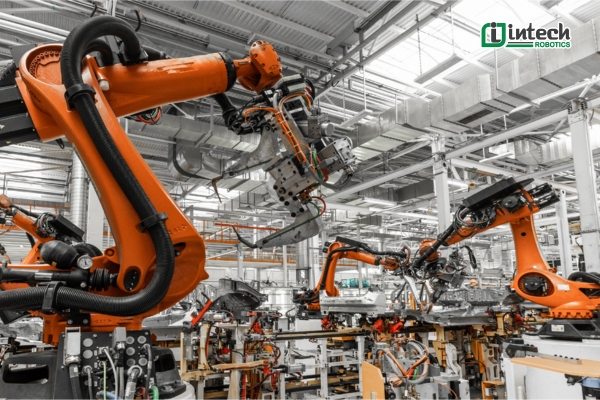
1. Industrial Robotic Arm
Classification of Robotic Arms
Palletizing robots are typically designed as open-chain robots. An open-chain robot includes:
-
A fixed link (base or support) serving as the foundation for the entire robot.
-
A series of dynamic links connected by revolving or prismatic joints, allowing the robotic arm to move flexibly in various directions.
The motors used in the joints are typically servo motors with position feedback. To increase torque and stability, robots are also integrated with planetary gearboxes or Harmonic Drive reducers, which help enhance durability and reduce errors during operation.
Features and Capabilities of the Robotic Arm
Palletizing robots are usually designed with six degrees of freedom, corresponding to six main joints, allowing the robot to move flexibly in three-dimensional space.
-
The first three degrees of freedom determine the position (coordinates) of the end of the arm in space.
-
The remaining three degrees of freedom determine the orientation and tilt angle of the gripper, allowing the robot to approach goods from many different directions.
With inverse kinematics providing a unique solution, the robot ensures smooth, accurate, and stable movement throughout its operation.
2. Grippers and End Effectors
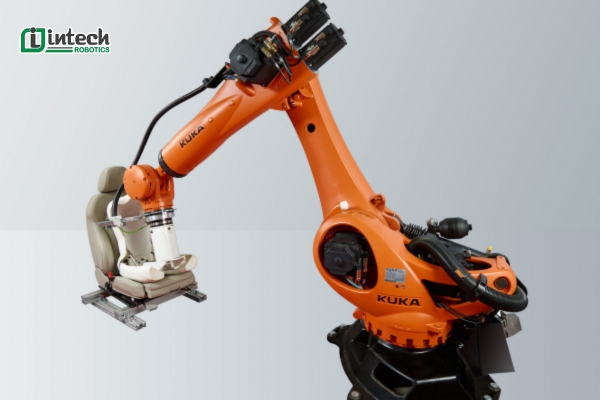
In a palletizing robot, the gripper, also known as the end effector, is responsible for directly contacting the goods to pick, lift, move, and stack them onto the pallet.
Types of Grippers and End Effectors Used
End effectors are designed according to the nature of the product and the task to be performed, ensuring the robot can handle a wide variety of goods from bags, boxes, and cartons to metal parts, plastic blocks, or products with flat surfaces.
Common types include:
- Mechanical Grippers: Use fingers to securely hold products, used for goods with fixed shapes and high friction such as boxes, blocks, or bags.
- Pneumatic Grippers: Use compressed air pressure to open and close the fingers, allowing the robot to operate quickly and accurately.
- Electric Grippers: Controlled by electric motors, suitable for applications requiring stable gripping force and precise control.
- Electromagnets: Used for goods made of magnetic metal materials. The lifting capacity depends on the thickness, type of material, and magnet power.
- Vacuum Suction Cups: Use suction force to lift products with flat, smooth surfaces such as plastic packaging, cartons, or metal sheets. The payload depends on surface flatness and vacuum power.

Functions and Features of the Gripper
The gripper helps secure the product, lift it, move it along a predefined trajectory, and place it correctly on the pallet. The robot can rotate, tilt, or translate flexibly, ensuring accurate handling even in tight spaces or environments with obstacles.
Key Features:
- Capable of picking various types of goods with different sizes and shapes within the allowable payload limit.
- Thanks to smart sensor and control systems, the robot can adjust the gripping force to suit each product type, avoiding damage to the goods.
- Gripper surfaces can be designed with increased friction or special features to enhance grip, ensuring the product does not slip or fall.
Practical Applications of End Effectors
- Bag, sack, or carton palletizing robots: Use pneumatic or mechanical grippers to ensure fast and safe handling.
- Metal part handling robots: Use electromagnets or vacuum cups to move heavy materials, ensuring a firm grip.
- Plastic or packaging palletizing robots: Apply vacuum grippers to lift lightweight products, avoiding surface deformation.
Advantages of Palletizing Robots
Palletizing robots can be easily integrated into existing production lines or conveyor systems. Additionally, the ability to program and customize flexibly helps robots meet various production requirements.
Integration with Conveyor Systems
Palletizing robots have the ability to connect directly with conveyors, packaging machines, or automated feeding systems to ensure a continuous handling process.
- Integration mainly depends on the robot's workspace, floor area, and workshop layout.
- The robot only requires a compact, well-arranged workspace to ensure an unobstructed trajectory while still easily accessing products from the conveyor.
- Robots can integrate with various systems, from conveyors and stretch wrappers to Automated Warehouse Management Systems (WMS, ERP).

Flexible Programming and Customization
Palletizing robots support multiple programming methods, helping users easily set up, adjust, and optimize the operation process:
- Pendant Programming: Use a handheld Teach Pendant to move the robot to desired positions, enabling quick, intuitive setup suitable for most current industrial robots.
- Specialized Software Programming: Major robot brands like ABB and KUKA provide specialized programming and simulation software that allows for programming, simulation, and uploading programs to the robot without stopping operations.
- Teach-by-Demonstration: The operator can directly move the robot arm to positions to be remembered, and the system saves the coordinates and path. Commonly used for small robots or cobots, helping to shorten training and setup time.
User Interface and Monitoring Systems
Due to the nature of continuous operation and exposure to industrial environments, palletizing robots do not integrate control screens directly on the robot body.
- The entire control and monitoring interface is integrated into a central controller or a connected computer.
- Operators can monitor robot status, speed, gripping force, trajectory, and error warnings directly on the control screen.
- Some advanced systems also support industrial network connections (Ethernet/IP, Profinet), allowing remote monitoring and control of the robot through production management software.
Applications of Palletizing Robots in Industries
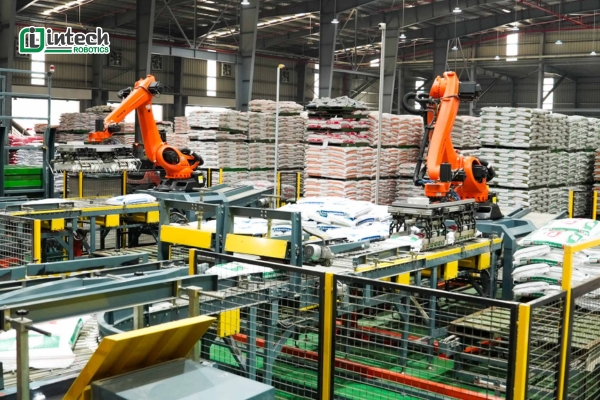
Palletizing robots are widely used in many manufacturing sectors thanks to their ability to stack goods quickly, accurately, and safely, helping businesses automate packaging and transport processes, reduce labor costs, and improve productivity.
-
Food and Beverage Industry: Robots are used to stack bottles, boxes, bags, or packaged containers onto pallets, ensuring warehousing and transport processes are fast, synchronized, and hygienic.
-
Electronics Components Industry: Robots can stack small parts, electronic components, or circuit boards into containers or pallets with high precision, limiting damage during handling.
-
Pharmaceutical and Medical Industry: Robots help stack medications, medical devices, or packaged supplies onto pallets, meeting strict safety standards and minimizing operational errors.
Conclusion
With stable operation, high precision, and easy integration into production lines, palletizing robots are becoming an essential automation solution in modern factories. Intech Robotics is proud to be a unit with over 15 years of experience in deploying industrial automation systems such as product sorting lines, automated packaging & palletizing lines, cargo transport lines, etc., trusted by hundreds of domestic and international enterprises. Contact Intech Robotics today for support.
